
Thursday, September 22, 2016


Saturday, September 17, 2016
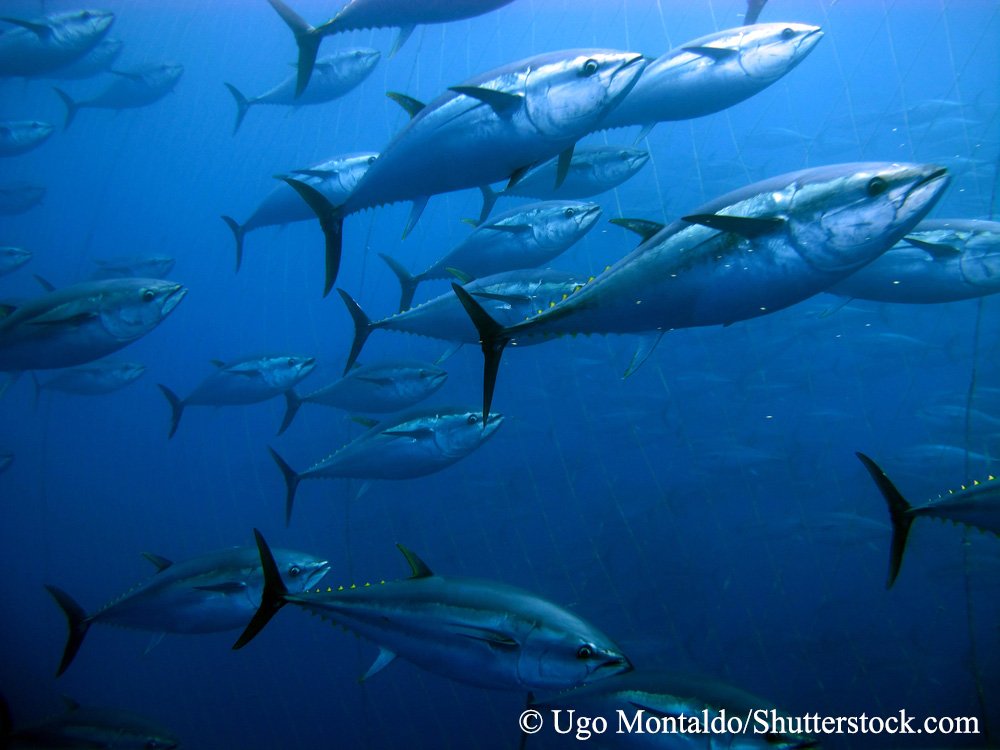
UK to ban fishing from a million square kilometres of ocean.
UK to ban fishing from a million square kilometres of ocean. https://www.theguardian.com/environment/2016/sep/15/uk-to-ban-fishing-from-a-million-square-kilometres-of-ocean …
Sunday, September 4, 2016
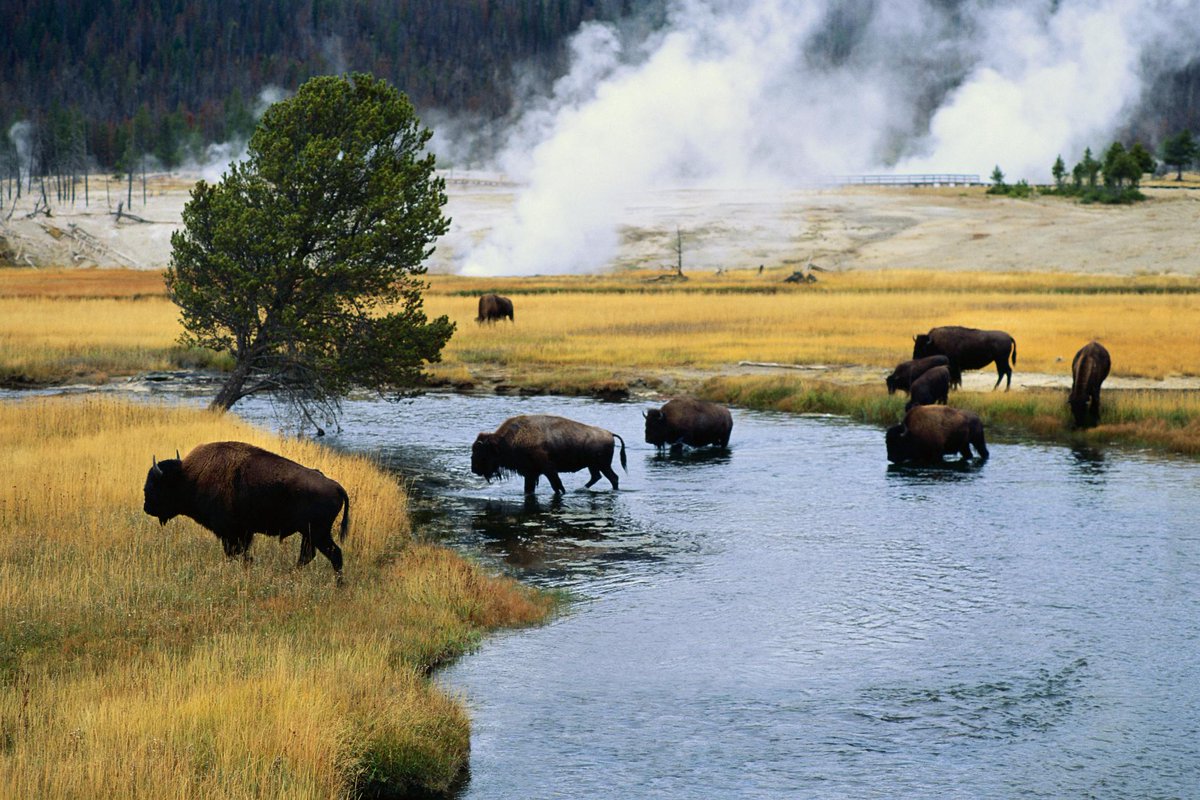
Bison Herds
Male and female bison live in separate herds, coming together to breed in the summer.
Source:
Wednesday, July 20, 2016

Tuesday, July 19, 2016
Wild Spix's Macaw spotted in Brazil
 BirdLife
BREAKING. Extinct in the wild or not? Wild Spix's Macaw spotted in #Brazil this week! http://goo.gl/sWSLtT #birds

Thursday, July 7, 2016
Wednesday, July 6, 2016
Spyderco Tool Used in Ongoing Effort to Save Whales


Saving Whales
In 2006, off the coasts of Australia, there were 21 reported cases of large whales entangled in various fishing gear. Of those, there were 4 confirmed deaths, 9 whose fate is unknown (but likely grim) and 8 who were rescued. Whales are dying. There's no way of knowing exact numbers because these are only the whales that were spotted. These numbers are likely to increase.
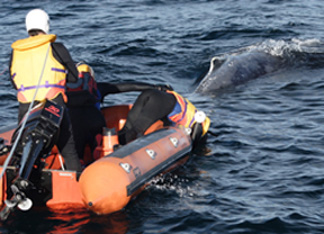
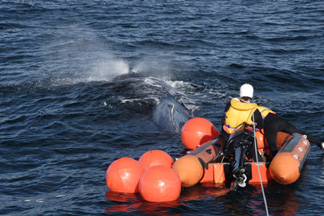
Australian Whale Rescue teams go out in to the open waters of the Indian Ocean in a tiny inflatable raft to save these creatures. They go in a team of three and hang over the tiny raft reaching in to the depths of the sea to cut lines of rope and gear off of a frightened, stressed animal. Often these entangled whales are 8-12 meters (26-39 feet) in length and weigh in at several tons?
Doug Coughran (Senior Wildlife Officer, Western Australia Department of Environment and Conservation) knew they needed a specialized blade to make their rescues more effective and safer for their rescue teams. Doug contacted Jim Steele, a knife maker, about designing a new blade to be deployed on a ten foot pole.
Jim Steele designed a special blade and immediately thought of the SpyderEdge. He explained to Doug that the Spyderco serrations were the only thing that he knew of that would make the blade work the way they need it to. He suggested Doug contact Spyderco.
Spyderco had been working with the Provincetown Center for Coastal Studies in Massachusetts. Doug Coughran explained rescue needs to Spyderco president, Sal Glesser and asked if his company could make such a blade. These blades would be large, expensive and difficult to make. The decreasing radius Hawkbill blade alone was a challenge, to put a SpyderEdge on it required a great deal of skill.
Spyderco undertook the project to make a contribution to a worthwhile cause. The first blade, shipped to Doug in time for Australia's national workshop for Large Whale Disentanglement. During this workshop Doug was able to demonstrate the new Spyderco Whale Rescue Blade to his colleagues on 40mm and 50mm rope; they were stunned by the blade's performance.
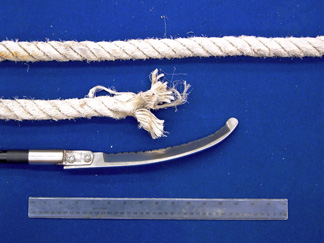
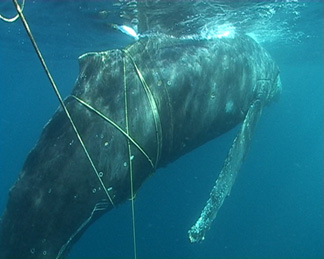
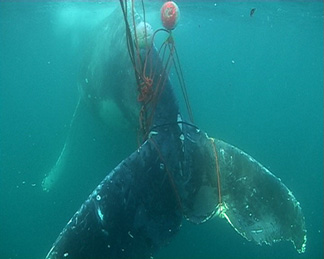
Just two days after receiving the blade, it was put to work in its first rescue. A 10m Humpback Whale had become entangled and anchored by two sets of pot gear. After a meticulous process of assessing the rope wraps, a sequence of 5 cuts disentangled the whale 6 weeks later the blade was also instrumental in the release of a pregnant humpback whale, entangled and anchored by two sets of pot gear which had wrapped around her tail in excess of ten times. There was a very large shark circling her, sharks often prey on entangled whales.
To date, there have been 5 whales (and one unborn calf) rescued using the Spyderco Whale Rescue Blade. As this is written, it's early Spring here in the U.S., we're coming up on another season in Australia, We hope the blade continues to make the same difference this year.
The first 20 blades were given to the Western Australia Department of Environment and Conservation and to Baden H Lane, Manager (Shark Control Program), Queensland Boating and Fisheries Patrol. There are now 48 blades being used in Australia and off the Eastern Coast of the United States. Spyderco loses well over a hundred dollars on every blade, but we think there is a bigger picture here than money. We appreciate the chance to be able to help make a difference. The risk these rescue teams take is to be commended.

June 30, 2016
Fast Forward: Spyderco tells us the saga continues and the situation worsens for whales worldwide
Whale entanglements are on the rise. In 2015, the National Oceanic and Atmospheric Administration reported 61 incidents of whale entanglements along the West Coast. That’s the most since the NOAA started keeping records in 1982.
On Monday, an 80-foot blue whale entangled in crab traps and lines attached to buoys was spotted off the coast of Orange County. Blue whales are endangered after being hunted mercilessly by whalers for decades, so losing whales in this way is tragic.
That’s where Spyderco comes into the picture.
Here’s an excerpt from the Washington Post about the rescue attempt:
On the West Coast , a fleet of rescue boats from local business and law enforcement set out into the Pacific, to free a Blue Whale, an endangered species, entangled in fishing equipment.
For hours on Monday, they tracked the struggling whale, Reuters reported, at times getting close enough to dip long poles into the water while the animal surfaced to breathe. At the end of the pole were cutters, used to slice away at the entanglement.
This cutter is a specialized tool designed by the folks at Spyderco called Whale Rescue Blade.
Spyderco agreed to make something so specialized because they care about whales and all wildlife.
Ocean wildlife is under constant threat from all directions, whether it’s predators in the sea or gyres of marine debris particles. Humans are by far the largest threat to the ocean biodiversity, so this is just a step in making things right.
The blue whale entangled off the Pacific Coast grew agitated at the attention and dove deep beneath the surface. Rescuers are still on the lookout and will undoubtedly use the Spyderco Whale Rescue Tool, if the whale is spotted again.
Link: https://www.spyderco.com/catalog/details.php?product=279
Update:
No Sign of Entangled Blue Whale off Southern California
By The Associated Press
A blue whale entangled in crab pot line has remained out of sight since rescuers off the Southern California coast unsuccessfully tried to free the giant mammal earlier this week.
Dave Anderson of Capt. Dave's Dolphin and Whale Watching Safari said
Thursday that boaters and even volunteers in airplanes have looked for
the whale since it dove and disappeared near nightfall Monday after the
rescue effort off Dana Point.
Anderson says he has seen other blue whales feeding on krill in the area
but not the one with about 200 feet of thin line tangled either around a
flipper or the mouth.
He says it would be normal for a blue whale to be feeding off California
at this time of year and wouldn't be surprised if it's spotted again.
Link: http://abcnews.go.com/US/wireStory/sign-entangled-blue-whale-off-southern-california-40262203
Marine Mammals Center
http://www.marinemammalcenter.org/about-us/News-Room/Latest-News/?gclid=CjwKEAjw2PK7BRDPz5nDh9GjoGcSJAAybcS36QhcY302fCF4wlAg_uPr468ZRYdY9ZubELEjZkeQxhoCJm7w_wcB
Friday, June 17, 2016
Great blue herons 'masters of camouflage and patience'

A great blue heron catches a tasty meal.
Great blue herons 'masters of camouflage and patience'
by Sandy Fairfield - Comox Valley Record
posted May 1, 2013 at 2:00 PM
Elegant and graceful, great blue herons are one of nature's most beautiful birds, and they are very visible along the shorelines of the Comox Valley and the Campbell River area.
The largest heron found in Canada, the great blue prefer shallow coastal waters, marshes, wet lands and river estuaries.
Local populations are year round residents, while others will migrate south to Mexico and northern South American countries.
Great blue herons are tall long-necked birds with a compact body, standing over a meter in height and weighing up to two and a half kilograms. Long fragile-looking legs stand on large splayed feet that are partially webbed, allowing them to wade in water or walk on shallow vegetation.
These herons have the ability to stretch out their necks or point their heads at different angles to blend in with their environment; when flying their necks double back to rest on their shoulders and their feet trail stretched out behind them.
Great blue herons have very distinct grey blue plumage in the adults with white breasts streaked with black. They also have white cheek pouches and pale grey necks.
During the breeding season the males grow long, impressive, slender, trailing black feathers on their necks, breasts, flanks, and backs.
Masters of camouflage and patience, these herons are stealthy hunters, standing motionless, moving only their eyes as they wait for their prey to swim by or they will silently stalk the unsuspecting food. Moving with great speed and agility the herons strike with their beaks to catch their prey — they do not impale their catch but use their beak like a pair of tweezers snatching the fish out of the water before tossing it up to be consumed head first to easily pass down the throat.
Although fish are one of the favourite food choices great blues will also dine on crustaceans, frogs, small rodents and other small aquatic creatures.
Great blue herons are very unique nesters, the most obvious choice for a nest would be in some kind of wetland similar to swans, but instead these lanky birds prefer to build their nests in the tree tops, forming a heronry, or rookery.
Usually solitary birds, the breeding season brings dozens of birds together with the males choosing the nest site, and both birds incubating the turquoise blue eggs.
Heron nests are very exposed and their successful breeding requires dedicated parents to guard the nest from predators, a task they share in order to deter attacks on the nest by ravens, crows and eagles.
Usually these birds will produce between seven and 11 eggs but the mortality rate is very high and often only one will hatch and survive the first year.
Baby herons are extremely comical with large beaks and a crown of fluffy down; many hatchlings will never make it to fledge from the nest as they are often pushed out of the nest by a sibling in the struggle to compete for food. Once they fall from the nest few will survive as the dense vegetation under the nest prevents the adults from being able to feed them on the ground.
Great blue herons are very difficult birds to rehabilitate as they are highly strung, easily spooked and secretive by nature; rehab housing has to provide a safe place for them to hide where they cannot see humans.
Do not try to attempt a rescue of an adult bird; they can be very aggressive, striking out with their beaks aiming for the predators' eyes.
M.A.R.S. initiated a great blue heron study made possible by funding from Shell Canada. We will be monitoring feeding areas and nest sites to find out more about their feeding and nesting habits.
Herons can be seen along the Comox Valley shorelines from Union Bay to the Oyster River, sometimes as a solitary fisherman while others as a larger group.
Some heronries are reused each year others abandoned, some like the Stanley Park colony seem to have adapted to urbanization along with the noise of traffic, sirens and general big city sounds.
Please try not to approach the herons, take photos from a safe distance and again, please do not let dogs chase the birds; these herons and their nests are protected and blue listed in B.C.
In the next few weeks we expect many wildlife species to be teaching their offspring the necessary life skills they need to survive, so please expect fawns and other mammals to be more visible use caution when driving.
If you find baby wildlife please call 1-800-304-9968 before intervening if a rescue seems needed please be aware of the exact location of the creature.
For general information call 250-337-2021 or visit our web site at www.wingtips.org.
Sandy Fairfield is the educational co-ordinator for the Mountainaire Avian Rescue Society (MARS). The MARS column appears every second Thursday.
Link: http://www.comoxvalleyrecord.com/lifestyles/205671471.html
Related Stories
Author Mackie at Blue Heron
Camouflage pants draw criticism from Quebec premier
Herons familiar sight on the coast
Green herons 'extremely secretive' birds
Syncrude faces order after heron deaths
Stanley Park's mating herons debut online
Mountainaire Avian Rescue Society has rescued two young herons in last few weeks

Locally extinct bird 'rediscovered' after 178 years
Locally extinct bird 'rediscovered' after 178 years
It's estimated 99 per cent of all species that have ever existed on Earth are now extinct, but for some, the term is revoked after being rediscovered decades – or even centuries – later.
The red-faced liocichla (Liocichla phoenicea) hasn’t been spotted for 178 years and was thought to be locally extinct, according to Australian Geographic. A group of ornithologists spotted the bird on a 10-day bird watching tour.

The bird-watching group originally saw just two red-faced liocichlas, but when they returned to the spot the next day, they saw eight birds, including a male-female pair, Australian Geographic reported.
“When we confirmed it was the red-faced liocichla we all felt so happy—we were so excited,” Tikaram Giri, a senior field ornithologist, said. “We never thought and never expected to see it so easily.”

Discoveries of species previously thought to be extinct are not uncommon, Australian Geographic said. Several species of birds, mammals, insects, reptiles and plants have been rediscovered after years of no sightings.
Diana Fisher, University of Queensland fellow, said about a third of all mammals ever feared to be extinct have been rediscovered.
“There are large numbers of poorly known species around the world only known from a single museum specimen as well,” Fisher told Australia Geographic. “So it is hard to know anything much about them or where they exist.”

Nepal is home to 878 species of birds, 8 percent of the world’s known birds. Even with the abundance, a lot of the species are close to being labeled as threatened.
“Nearly 20 percent of Nepal’s birds (167 species) are threatened with extinction in the country including 37 species which are threatened on a global scale,” the Zoological Society London wrote.
Another 62 species are closing in on having a threatened status, the Weather Channel reported. Nine species are believed to be extinct in Nepal because they have not been spotted since the 19th century.


More images for red-faced liocichla (Liocichla phoenicea).
Source: https://ecowatch.com/2016/06/15/nepal-extinct-bird-red-faced-liocichla/
Subscribe to:
Posts (Atom)